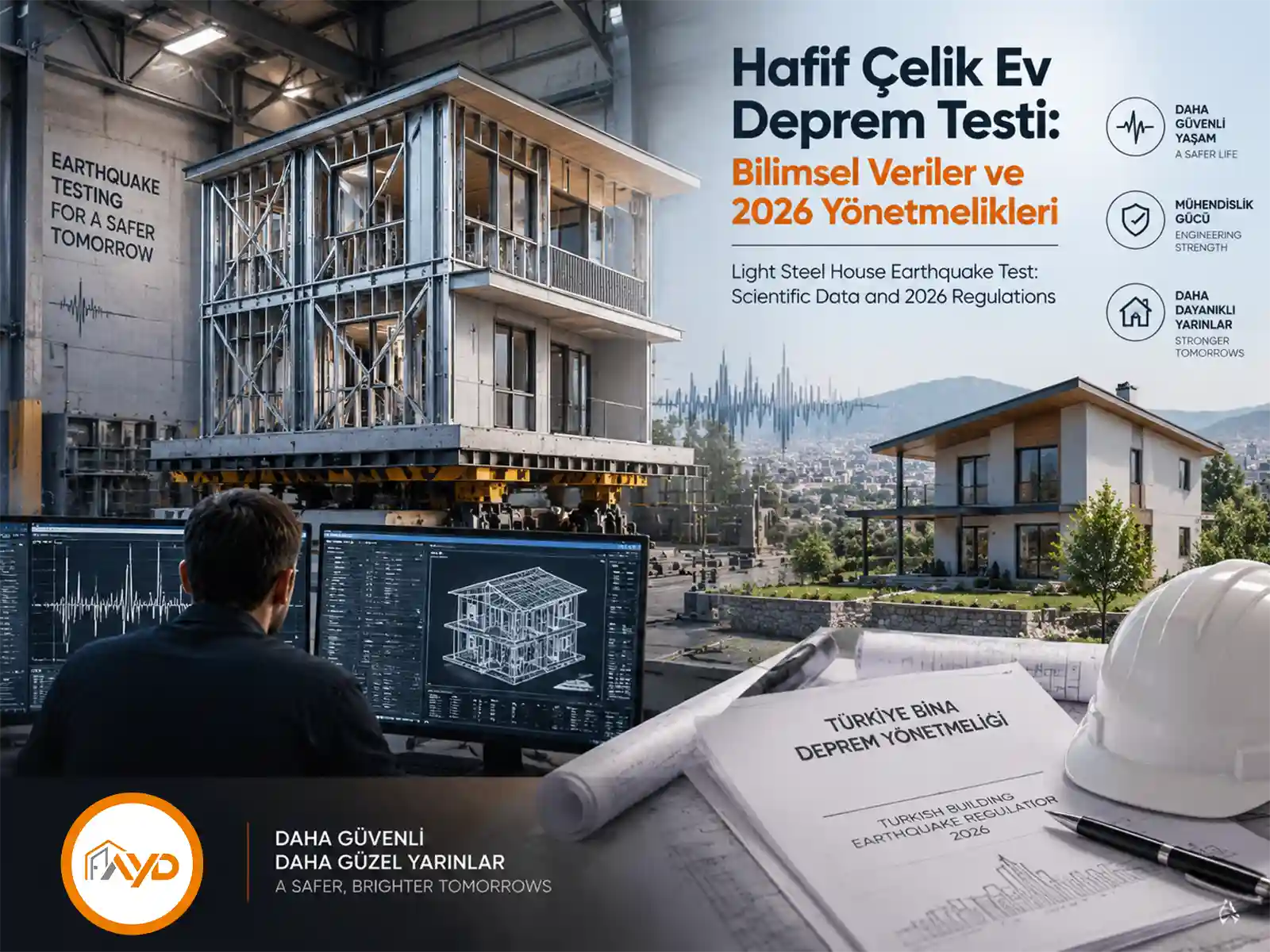
The data in this guide is compiled from the Turkish Building Earthquake Code (TBDY-2018), TS EN 1090-1/2, the AISI S100 cold-formed steel standard, and TUBITAK-MAM shaking table test reports.
Seismic performance values vary depending on the spectral acceleration, soil class and building geometry of the parcel. Final design must be validated through project-specific structural calculations and building inspection approval.
Light steel earthquake behavior: mass is everything
The seismic force on a building is summarized as F = m × a. As the building mass (m) increases, the force at the same ground acceleration (a) increases linearly. Light steel buildings weigh 60-90 kg per square meter, while reinforced concrete reaches 800-1200 kg. This difference is the main factor reducing seismic demand.
In shaking table tests at TUBITAK-MAM and ITU Structural Engineering laboratories, ground motion records from the 1999 Kocaeli (Mw 7.4) and 2023 Kahramanmaras (Mw 7.7) earthquakes were applied to light steel specimens; structural integrity was preserved.
- Light steel buildings are 8-12 times lighter than reinforced concrete.
- Lower mass means lower base shear force.
- Ductile behavior absorbs energy and protects the structure.
- Connections are designed to be ductile rather than brittle.
TBDY-2018: how the Turkish Earthquake Code treats light steel
TBDY-2018, effective from 1 January 2019, is the foundational code for all building design in Turkey. Cold-formed light steel profiles fall under Chapter 13 and hot-rolled steel under Chapter 9. The code defines performance through Ground Motion Levels (DD-1, DD-2, DD-3) and Building Performance Levels (CH, LS, CP).
TBDY-2018 also revised the earthquake zone map. Instead of the old four-zone system, spectral acceleration parameters (Ss, S1) are read from the AFAD Turkish Earthquake Hazard Map for each parcel. This shifts design from "zone-based" to "ground motion-based".
- Chapter 13 of TBDY-2018 covers cold-formed light steel profiles.
- Spectral acceleration values (Ss, S1) are read from the AFAD map.
- Earthquake Design Class (DTS) is set between 1 and 4.
- Building Use Class (BKS) is taken as BKS-3 for residential.
- The standard performance target is CH (Controlled Hazard).
R coefficient, ductility level and structural irregularities
The R structural response coefficient defines how much the elastic demand can be reduced. In TBDY-2018, R varies between 4 and 7 for braced light steel frames; high ductility (HD) systems carry the higher value. A larger R means lower section demand under design earthquake.
Plan and vertical irregularities (A1-A3, B1-B3) directly affect performance. Torsion, sudden stiffness loss or soft story formation must be controlled in light steel design as well. Regular geometry, symmetrical plan and continuous bracing lines are the ideal approach.
- R is selected between 4-7 depending on ductility level.
- A1 torsional irregularity ratio must not exceed 1.2.
- B2 soft story irregularity needs care at ground floor.
- Overstrength factor D is used in capacity design.
- Bracing must be placed symmetrically and continuously.
TS EN 1090 and seismic test procedures
TS EN 1090-1/2 classifies the manufacturing and assembly quality of steel members. EXC2 applies for residential, EXC3 for high-importance structures like hospitals and schools. CE-marked profiles meet the requirements of this standard.
Shaking table tests apply recorded earthquake accelerations to scaled or full-size models. ISO 21581 and ASTM E2126 standardize cyclic horizontal load testing. The systems used by AYD Prefabrik are certified at accredited laboratories under these standards.
- TS EN 1090-2 manufacturing class is EXC2 for residential.
- Shaking table tests use real earthquake records.
- ISO 21581 and ASTM E2126 are cyclic loading protocols.
- CE-marked profiles meet the standard requirements.
- Connection tests are also performed under ASTM E2126.
Light steel vs reinforced concrete: seismic performance
For the same floor plan, the base shear of a light steel building is on average 70-80% lower than reinforced concrete. This reduces both foundation sizes and ground improvement needs.
Steel's ductile behavior allows seismic energy to be absorbed through plastic deformation. Whereas reinforced concrete manages brittle failure through plastic hinge regions, in light steel this behavior is achieved more reliably as a natural property of the material.
- Light steel base shear is 70-80% lower than reinforced concrete.
- Ductile behavior increases energy absorption capacity.
- Foundation and ground improvement costs decrease.
- Repairability is higher than reinforced concrete.
- Post-earthquake structural inspection is visually easier.
Earthquake zone map and parcel-based design
The Turkish Earthquake Hazard Map (AFAD, 2018) provides Ss and S1 spectral acceleration values for every coordinate. On parcels along the Marmara, Aegean fault zone, North Anatolian Fault Zone and East Anatolian Fault Zone, Ss values often exceed 1.0g. Design is done at the specific parcel coordinate.
When evaluated together with soil class (ZA-ZE), the design spectrum can differ for two parcels in the same region. For this reason, a soil survey report is mandatory in light steel projects as well and forms the basis of seismic design.
- Ss and S1 values are read parcel-by-parcel from AFAD.
- Soil class ranges from ZA (rock) to ZE (soft).
- Soil survey report is mandatory in the permit file.
- Buildings on the NAFZ are designed for high acceleration.
- Coefficients are increased for BKS-1 (hospitals etc.).
Related pages
Frequently Asked Questions
Is a light steel house really safer in an earthquake?
A light steel structure weighs 8-12 times less than reinforced concrete. Under the same ground acceleration, the seismic force on the building drops by the same proportion. With ductile design and TBDY-2018 compliant bracing, light steel delivers high seismic performance.
How does TBDY-2018 classify light steel?
Cold-formed light steel profiles are addressed under Chapter 13 of TBDY-2018. The code defines the R coefficient, ductility level and performance target through this chapter.
What is a seismic shaking table test?
A shaking table test is a laboratory experiment in which a real earthquake acceleration record is applied to a building model. These tests confirm that light steel systems preserve their integrity under records of magnitude 7.0+.
What is the R coefficient range for light steel?
According to TBDY-2018, R is selected between 4 and 7 for braced light steel frames. In high ductility systems the value increases and design section demand decreases.
Is the earthquake zone map still in use?
Instead of the old four-zone map, the AFAD Turkish Earthquake Hazard Map is now used. Ss and S1 spectral acceleration values are read for each parcel and design is based on these values.
Which TS EN 1090 class applies?
EXC2 applies for residential buildings, while EXC3 applies for high-importance structures such as hospitals and schools. CE-marked profiles meet the requirements of this standard.
Let us design your earthquake safety together
Share your earthquake zone and soil class. Our technical team will design your TBDY-2018 and TS EN 1090 compliant light steel system in line with your seismic performance targets.