The technical data in this guide is compiled from the Turkish Building Earthquake Code (TBDY 2018), TS 825 Thermal Insulation Rules in Buildings, and TURKSTAT Construction Cost Index.
Cost and time figures vary depending on project size, land conditions and regional labor cost. We recommend an on-site survey with our technical office before the final decision.
Cost comparison: why prefab leads on a per-m2 basis
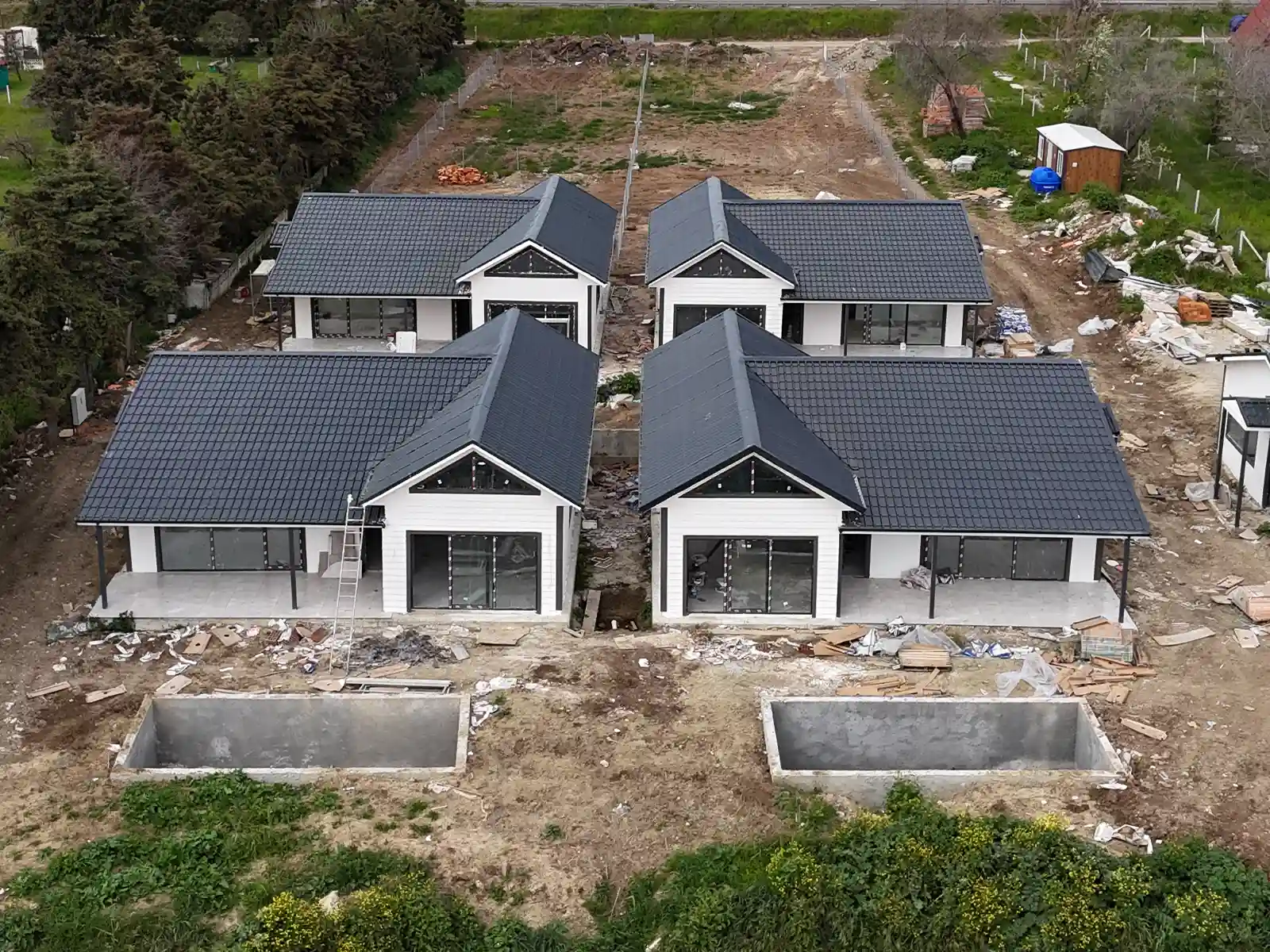
Prefab house cost relies heavily on the serial production of factory-made panels and steel framing. This serial production reduces material waste, labor time and on-site waiting costs. For the same living area, the cost per m2 of prefab is typically 25% to 40% more affordable than reinforced concrete.
In reinforced concrete construction, excavation, formwork, rebar, concrete, plaster and a long site duration push the cost upward. Especially in periods when the TURKSTAT Construction Cost Index rises, prefab provides clear price predictability and contractual delivery time as an investor safeguard.
- Prefab cost per m2 is lower thanks to serial production.
- In reinforced concrete, excavation, formwork and rebar form a major share of the total cost.
- Extended site duration continually drives the reinforced concrete budget up.
- A prefab contract makes fixed price and fixed delivery commitments easier.
Time difference: 3-4 months prefab, 12-18 months reinforced concrete
In prefab houses, production runs in parallel at the factory while only the foundation and infrastructure are completed on site. Thanks to this parallel progress, turnkey delivery stays within 3-4 months. Light steel systems remain in a similar range.
In reinforced concrete, excavation, foundation, columns and beams, slabs, walls, plaster, mechanical and electrical works progress sequentially. During this 12-18 month average process, weather and labor scheduling can cause delays, while financing cost also accumulates.
- Prefab production and site works run in parallel, shortening the schedule.
- Reinforced concrete site duration is sensitive to seasonal conditions.
- Long duration affects loan cost and rental expense.
- Fixed delivery commitments are easier to set on the prefab side.
Earthquake performance: two systems through the TBDY 2018 lens
The Turkish Building Earthquake Code 2018 (TBDY 2018) evaluates structural systems by ductility level, structural irregularities and ground motion parameters. The low self-weight of light steel frame systems directly reduces seismic demand, which makes it easier to evaluate them in the high ductility class.
In reinforced concrete buildings, performance depends on rebar detailing, concrete class and shear-wall ratio. A well-designed reinforced concrete building can perform very well, but its weight also increases seismic demand. The decision should consider the structural project, soil report and ductility class together.
- TBDY 2018 rewards systems with high ductile behavior.
- The low weight of the light steel frame reduces seismic demand.
- Rebar detailing and concrete class are critical in reinforced concrete.
- Soil class directly affects design in both systems.
Energy performance and the TS 825 thermal calculation
TS 825 Thermal Insulation Rules in Buildings define annual net energy demand and U-values for walls, roofs and floors per climate zone. Prefab panel systems reach low U-values thanks to their sandwich structure, lowering winter heating and summer cooling costs.
In reinforced concrete buildings, thermal insulation is achieved with an external facade system applied after plaster. With the right thickness, similar performance is possible, but the structural mass releases heat more slowly. Both systems are subject to the Energy Identity Certificate (EKB) requirement.
- Prefab sandwich panels reach low U-values easily.
- External insulation thickness is critical in reinforced concrete.
- TS 825 reports annual heating energy demand.
- EKB is mandatory in both systems for occupancy.
Investment payback and resale value
Investment payback describes how quickly the production cost is recovered through rent or use. Prefab buildings shorten the payback period on average compared to reinforced concrete thanks to short delivery time and lower cost per m2.
In resale value, the decisive factor is whether the permit and occupancy certificate are completed. A registered prefab or reinforced concrete building with EKB and a complete technical file gains visible value on the secondary market.
- Short delivery time reduces the payback period.
- Permit and occupancy are core value drivers in both systems.
- A registered building offers advantages in financing and sale.
- Maintenance quality directly affects resale value.
Decision matrix: which system for which scenario?
If your priority is fast delivery, fixed budget, low structural mass in seismic zones and high energy performance, prefab or light steel comes forward. Reinforced concrete may still be preferred for multi-story, high-density projects with bespoke architecture.
The decision should not rely on cost alone; zoning status, story count, intended use and delivery schedule must be considered together. AYD Prefabrik's technical office evaluates the project comparatively for both systems.
- Prefab is advantageous for fast delivery and fixed budget.
- Reinforced concrete may lead in tall and bespoke designs.
- Zoning and story count limit the system choice.
- A comparative survey ensures the healthiest decision.
Related pages
Frequently Asked Questions
How much cheaper is a prefab house compared to reinforced concrete?
For the same living area, prefab cost per m2 is typically 25-40% lower. The exact rate depends on the parcel, story count and technical package.
Which system is more advantageous in earthquake safety?
The low weight of light steel reduces seismic demand and can be evaluated in the high ductility class under TBDY 2018. A properly designed reinforced concrete building also performs well; the decision should rest on the structural project and soil report.
Can a prefab house be registered to the title deed and gain formal value like reinforced concrete?
Once the permit and occupancy are completed, a prefab house is registered and gains formal value. A registered prefab structure offers advantages in resale and financing.
Is prefab better in energy performance?
Prefab panel systems easily reach low U-values in the TS 825 calculation. In reinforced concrete, similar performance is possible with the right insulation thickness.
Which system leads in which scenario?
Prefab leads when fast delivery, fixed budget and low structural mass are priorities. Reinforced concrete remains an alternative for multi-story and bespoke architecture.
Is occupancy certificate granted in both systems?
Yes. Both prefab and reinforced concrete buildings receive an occupancy certificate when completed in line with the project and are documented with EKB.
Let us plan a comparative survey for your project
Share your land, budget and delivery target. Our technical office will place prefab and reinforced concrete options side by side and help you choose the best fit.